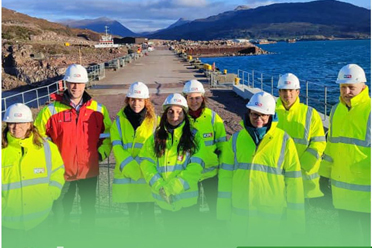
The SHEREC project is a collaboration of 16 partners from 10 European countries.
16 Partners

Safe, Healthy and Environmental Ship Recycling
Safe, Healthy and Environmental Ship Recycling

SHEREC is a project funded by the European Union’s Horizon Europe Research and Innovation programme. Its aim is to improve occupational health and safety in the ship recycling industry by integrating cutting-edge robotics, data, and AI systems.This is also a safeguard against contamination of the environment with hazardous substances.

The SHEREC project is a collaboration of 16 partners from 10 European countries. The partners include universities, companies, research institutes, and a non-governmental organization. The SHEREC consortium, coordinated by HKTM, can be divided into three groups based on their contributions: End-User Industry, Technology Providers and Social Sciences and Humanities (SSH) Expertise.

Funded by the European Union. Views and opinions expressed are however those of the author(s) only and do not necessarily reflect those of the European Union or the European Commission. Neither the European Union nor the granting authority can be held responsible for them.
This workshop will bring together leading researchers and industry practitioners to explore the growing role of robotics in the maritime industry. We will focus on the full lifecycle of a ship, from its initial construction and assembly to its ongoing maintenance and eventual recycling. The event will cover recent advancements in robotic perception, manipulation, and autonomous systems for large-scale, unstructured environments. Key topics include automated welding, non-destructive inspection, hull cleaning, and the safe and efficient dismantling of ships. The workshop aims to foster an interdisciplinary dialogue, bridging the gap between field robotics, industrial automation, and marine engineering communities.
Full day
Robotics for the Construction, Maintenance, and Recycling of Ships
• Name: Assoc. Prof. Evren Samur (Primary Contact Person) • Affiliation: Bogazici University, Dept. of Mechanical Engineering, Türkiye • Email: evren.samur@bogazici.edu.tr • Website/URL: https://haptics.bogazici.edu.tr/
• Name: Ekin Sakin • Affiliation: NGO Shipbreaking Platform • Email: ekin@shipbreakingplatform.org • Website/URL: https://shipbreakingplatform.org/• Name: Prof. Zoe Doulgeri • Affiliation: Aristotle University of Thessaloniki, Greece • Email: doulgeri@ece.auth.gr • Website/URL: https://arl.ee.auth.gr/people/doulgeri
• Name: Prof. Burkhard Corves • Affiliation: RWTH Aachen University • Email: corves@igmr.rwth-aachen.de • Website/URL: https://www.igmr.rwth-aachen.de/go/id/jkhpl/
• Name: Dr. Taufik Akbar Sitompul • Affiliation: Norwegian University of Science and Technology, Trondheim, Norway • Email: taufik.a.sitompul@ntnu.no • Website/URL: https://www.ntnu.edu/shorecontrol
• Name: Assoc. Prof. Ahmed Kedir Mohammed • Affiliation: SINTEF, Norway • Email: ahmed.mohammed@sintef.no • Website/URL: https://www.sintef.no/alle-ansatte/ansatt/ahmed.mohammed/
• Name: Prof. Erdal Kayacan • Affiliation: Paderborn University • Email: erdal.kayacan@uni-paderborn.de • Website/URL: https://en.ei.uni-paderborn.de/rat
• Name: Prof. Santiago Tapia • Affiliation: UPM, Madrid • Email: santiago.tapia@upm.es • Website/URL: https://cvar-upm.github.io/
Consortium Meeting / May 27-28 2025


The SHEREC project is a collaboration of 16 partners from 10 European countries.


Safe, Healthy and Environmental Ship Recycling

To semi-automate preparation activities in ship recycling using an AI-powered drone. A custom-designed aerial robot will navigate inside ships, overcoming GPS-denied environments and vision degradation in cluttered spaces. The drone will inspect ship interiors to verify, locate, and label hazardous materials based on the ship’s hazardous material inventory list.

To create an automated ship recycling plan using a digital twin of the ship and AI-based planning methods. A digital twin will be created using ship design documents and drone-collected data. AI-based planning algorithms will run on the digital twin to generate a cutting plan based on the virtual model’s details.

To semi-automate cutting and paint removal processes in ship recycling using two mobile robotic systems. The robots will operate autonomously or via tele-operation: one is a magnetic-tracked robot that can navigate the ship’s hull without external support, and the other is a mobile manipulator that moves inside the ship.
SHEREC PROJECT

A showcase of the enhanced human working conditions in the ship recycling sector, made possible by the SHEREC's pioneering technology.
Significant enhancement of the occupational and natural environments. The release of toxic gases and liquids is prevented in order to safeguard the ship recycling environment, residents, and laborers in the vicinity of the ship recycling yard.
Product development agreements. The consortium partners will enter into commercial agreements to promote the solutions.
The end users will integrate and implement the solutions, thereby improving the accuracy and reliability of ship recycling processes.
SHEREC PROJECT

Robotics, data and AI systems for ship recycling ship recycling, involving the dismantling of ships, poses significant risks, with high levels of fatalities, injuries and work-related diseases despite international regulations.
The sector also faces challenges related to inadequate waste management, leading to the contamination of coastal areas with toxic waste. In response to these issues, the EU-funded SHEREC project will introduce innovative robotics, data and AI systems to the ship recycling industry to set new standards for worker safety and environmental responsibility.
The project envisions the use of an AI-powered drone to locate hazardous materials, while a digital twin of the ship and AI-based planning methods will automate the ship’s recycling plan. In addition, two mobile robotic systems will be introduced to robotise cutting and paint removal processes.
The following objectives will be pursued in the SHEREC project to increase labor safety and make positive environmental impact.
SHEREC PROJECT | Safe, Healthy and Environmental Ship Recycling
2026 © Designed and Developed by creaUS